
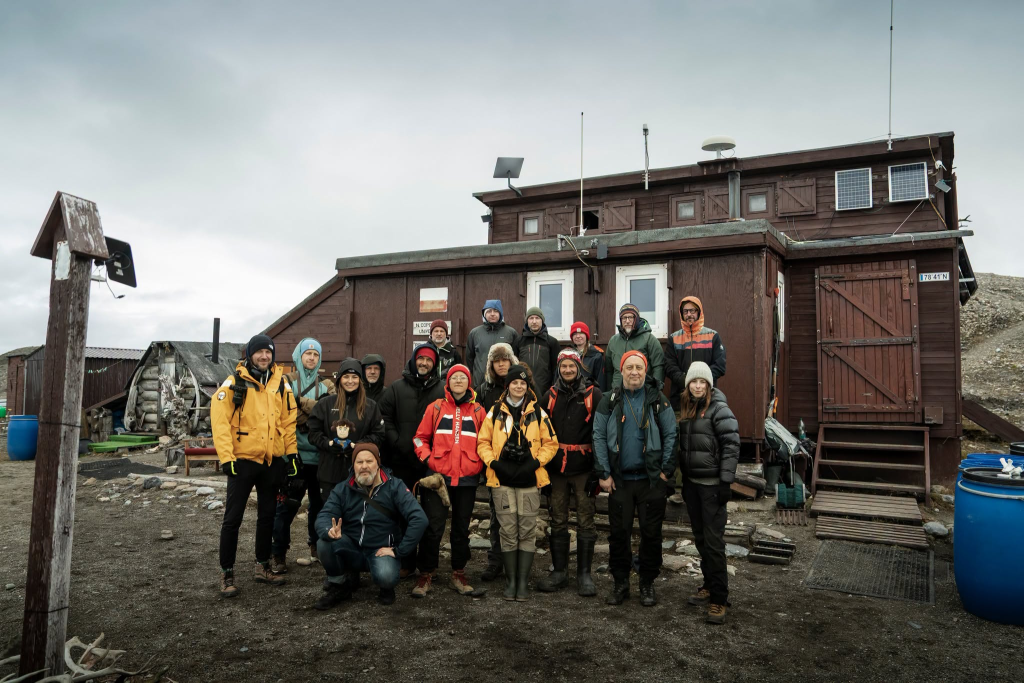
On 10 August, the band Organek will set off for Spitsbergen to join researchers from the Nicolaus Copernicus University in Toruń in telling the story of a place where the effects of climate change can be seen almost from one day to the next. This will mark the start of the project entitled “Science. Music. The Arctic.”
The aim of the expedition will be to produce a documentary film about the research being carried out on Spitsbergen by researchers from the Nicolaus Copernicus University. The narrative will be guided by Tomasz Organek, a musician, alumnus and the NCU Ambassador, who will join the expedition alongside his band. His encounters with the researchers and the Arctic will take viewers on a journey through a story about a place where the effects of climate change are becoming apparent more quickly than in most other regions of the world.
Music will also be performed against this extraordinary Arctic backdrop. The band Organek has planned an intimate, acoustic performance near the Nicolaus Copernicus University Polar Station, at the foot of a melting glacier – naturally, only to the extent permitted by weather and organisational conditions. This will not be a concert or a commercial event. The artists are taking part in the project free of charge, treating it as a joint endeavour aimed at popularising science and drawing attention to the challenges facing the modern Arctic.
We’re not going to Spitsbergen to play a concert. We’re joining this expedition because we believe that science can also be communicated through emotions. The music is meant to capture people’s attention and encourage them to ask questions about a world that is changing, says Tomasz Organek.
The artistic highlight of the project will be a new song by Tomasz Organek, inspired by Spitsbergen and the climate change taking place there. The song was written especially for the expedition and will be premiered once it has concluded. “It won’t be a song solely about the Arctic. It’s a song about disappearance – of landscapes and places, but also of what we perceive as permanent in life. I’d like to capture at least some of the emotions that accompany an encounter with this place,” adds Tomasz Organek.
The project aims to demonstrate that modern scientific communication requires new ways of reaching audiences. Music helps to draw attention to the research carried out by the Nicolaus Copernicus University and the challenges facing the Arctic today.
The university should not only conduct research, but also be able to communicate it effectively. Today, knowledge competes for the public’s attention with thousands of other messages. That is why we are seeking new ways to popularise science. The concept for the project originated at the “Od Nowa” Academic Centre for Culture and the Arts. From the outset, we recognised that this was an excellent way to combine the potential of the Nicolaus Copernicus University researchers with the language of culture and to bring their stories to a wide audience. Documentary film and music can reach people who might never pick up a scientific publication, but who want to understand the world they live in better. In this project, music is not the goal – it is a tool leading to science, says Prof. Adam Kola, Vice-Rector of the Nicolaus Copernicus University in Toruń.
The researchers from Toruń have been conducting investigations into the functioning of the polar environment on Spitsbergen for many years. The Waldemar Glacier remains a particular focus of their observations, and changes to it have been systematically documented by the researchers. Filming will take place in the vicinity of the Nicolaus Copernicus University Polar Station and the glacier. The documentary will provide a behind-the-scenes look at the scientists’ work, as well as highlight the importance of their observations for understanding the changes taking place on our planet.
The Arctic is one of the best laboratories for observing the changes taking place on Earth. What we are documenting on Spitsbergen helps us to understand better the processes that will also be significant for other regions of the world in the future. Each successive research season brings new data and demonstrates just how dynamically the polar environment is changing. I hope that, thanks to this project, the knowledge gathered over the years will also reach people who do not follow scientific research on a daily basis, emphasises Prof. Ireneusz Sobota, head of the Nicolaus Copernicus University Polar Station on Spitsbergen.
Once the expedition is over, it will be time for the next stages of the project. The most important of these will be a documentary film, new music from the band Organek – including a debut single inspired by Spitsbergen – as well as educational, photographic and multimedia materials. The project will be rounded off by meetings with the film’s creators, scientists and musicians, special screenings and activities aimed at raising awareness of the Arctic.
The most interesting projects today emerge where different ways of telling stories about the world come together. Scientists provide the knowledge, whilst artists help to bring it to life. This enables us to reach people who would not normally be interested in the research being carried out on Spitsbergen, says Roman Tondel, director of the “Od Nowa” Academic Centre for Culture and the Arts and the project’s initiator.
This initiative by the Toruń university demonstrates that the significance of scientific research extends beyond publications and conferences. The knowledge gained by researchers from the Nicolaus Copernicus University in Toruń on Spitsbergen can serve as a starting point for a broader discussion on climate change, environmental responsibility and the challenges facing society as a whole. In this way, research conducted in the Arctic also takes on an educational and social dimension.
Source: Information Portal NCU