
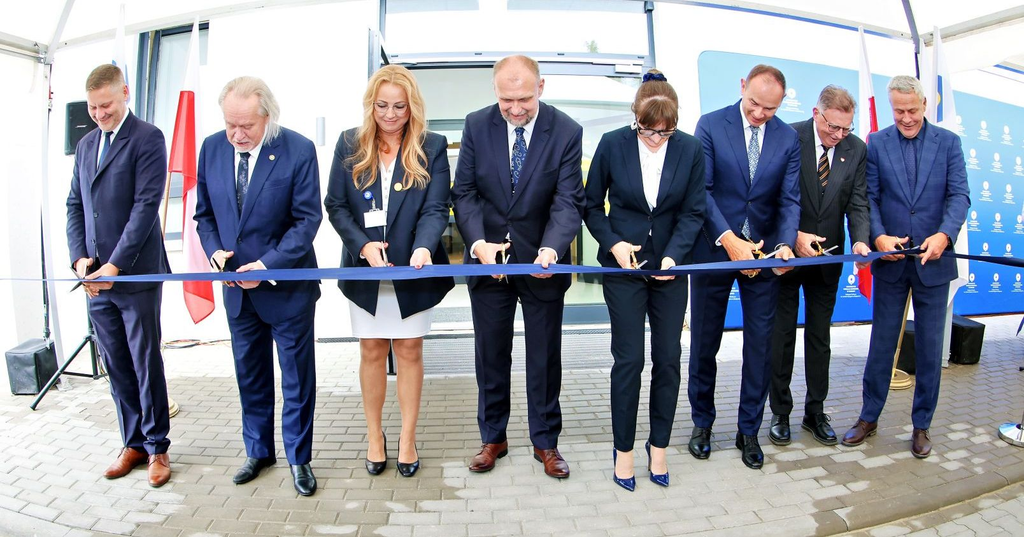
Four floor levels above ground, over 4,600 square metres of usable floor space, a clinical area, teaching facilities and an Examination Centre – all designed, built and fitted out within 14 months – the Nicolaus Copernicus University Centre for Dentistry has opened in Bydgoszcz.
This year’s opening of the academic year coincides with the launch of the state-of-the-art University Centre for Dentistry. “This is a dream come true. – I would like to extend my heartfelt thanks to everyone involved in this project, which has already made its mark on the history of construction, not just in the medical sector,” said prof. dr habil. Andrzej Tretyn, NCU Rector during the ceremony on Thursday. “Now all that remains is for us to await the first dentistry graduates. They will certainly be in high demand on the labour market, as they will be prepared for the jobs of the future. Artificial intelligence and 3D printers will hold no secrets for them. The admissions process alone has shown that we are well regarded amongst secondary school leavers. There were 41 applicants for every place. And this building will ensure that another record is broken next year.
The opening of the Centre, located on the premises of the Dr Jan Biziel University Hospital No. 2 in Bydgoszcz, was attended by, amongst others, the rectors of universities in Bydgoszcz, academics, members of parliament, and officials from Bydgoszcz and the Kujawsko-Pomorskie Voivodeship.
The building will provide training for, amongst others, dentists, paediatric dentists, orthodontists, radiologists, oral surgeons, periodontists and prosthodontists. It will house specialist dental clinics, including an out-of-hours and public holiday service, as well as radiological diagnostics, including CT scans. The facility will include teaching spaces, and on the top floor an advanced Examination Centre has been established with 142 computer workstations, including two adapted for people with disabilities. This will enable examinations to be conducted under conditions of maximum standardisation and comfort.
In October, third-year students of the medical and dental programme will return to the NCU Collegium Medicum, where they will begin their practical classes.
The University Centre for Dentistry has been equipped with modern facilities for pre-clinical teaching, including phantom units and virtual haptic units, according to prof. dr habil. Paweł Burduk, the Rector’s representative for the development of the medical and dental programme. – In addition, the Centre is equipped with clinical units used for teaching, as well as for treating patients from Bydgoszcz and the Kujawsko-Pomorskie Voivodeship. The Centre also has modern diagnostic, orthodontic and prosthetic equipment at its disposal.
Phantom units, also known as simulation units, are advanced teaching stations used in the training of dental students, which enable them to practise procedures in a pre-clinical setting. The set comprises a dental chair, a dentist’s console, lighting and a manikin with a head and a faithful replica of human teeth with a hardness similar to that of natural tissues. When using the virtual haptic dental unit, the student wears 3D glasses or looks at a three-dimensional screen, viewing a highly accurate digital model of the oral cavity, teeth and instruments (e.g. drills). The hand-held tip (manipulator) offers physical resistance, mimicking the hardness of real tissues. Whilst working, the student can physically feel the difference between hard enamel, soft carious dentine and the empty space of the tooth cavity. A clinical unit, on the other hand, is an integrated, technologically advanced working system designed for carrying out dental procedures, commonly known as a dental chair.
The construction of the University Centre for Dentistry was a challenge due to the very limited timeframe for its completion. The contractor – 3R Modular from Michałowice – had just 14 months to design the building, obtain planning permission and erect the structure. This timeframe was set by the Ministry of Health, which had funds available from the National Recovery Plan. The university authorities signed the contract with the construction company on 7 May 2025. – This was only possible thanks to the use of a unique technology – modular technology – explained Eng. Łukasz Niedźwiecki and Head of the Investment Projects Department at the NCU Collegium Medicum. – While we were applying for planning permission, technical work on the steel structure was already underway in Ostrowiec Świętokrzyski. By the time the foundations were laid, the building was essentially complete. You could say it was built in Ostrowiec Świętokrzyski. We used 104 modules. Each of them had the floor area of a small flat, around 46 square metres.
The logistics – that is, transporting the modules to Bydgoszcz – proved to be a difficult task. They were unloaded straight from the heavy trucks onto the building site, stacked on top of one another and bolted together. The building was erected in just under 20 days. It is not connected to the foundations. Its weight, nearly 2,500 tonnes, ensures that the structure is stable.
The large number of installations posed an additional challenge,’ said Eng. Łukasz Niedźwiecki. – Modern technological solutions required the laying of over 200 km of IT cables, around 100 km of power cables and several dozen kilometres of ventilation ducts. The building was completed in just under 10 months, from the ground-breaking ceremony to final handover.
The scope of the contract also included the development of the site, comprising, among other things, car parks, access roads, pavements, street fixtures and fittings, and the construction of the necessary technical infrastructure.
Source: NCU news