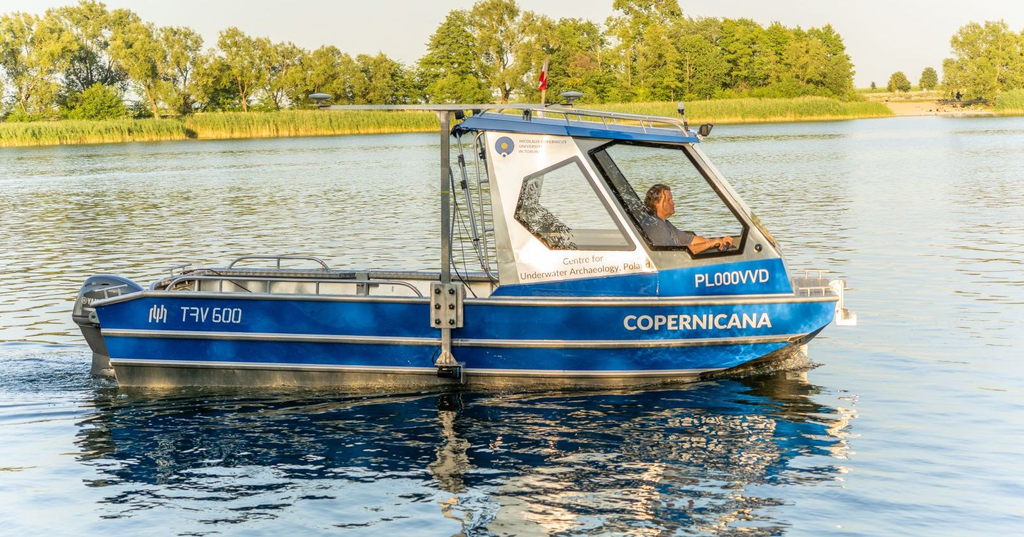
Copernicana, a boat owned by the Center for Underwater Archaeology at the Nicolaus Copernicus University in Toruń, facilitates the performance of precise hydrographic measurements and a broad range of research. Copernicana can also serve as a diving support vessel.
The research vessel Copernicana is a mobile platform which enables advanced scientific projects to be carried out in places such as lakes, rivers, and coastal waters. – Purchasing such new equipment opens a new page in the activity of the Centre for Underwater Archaeology, says Dr hab. Andrzej Pydyn, Prof. NCU. – Last year, we received a multibeam echosounder, professional equipment which allows mapping the underwater areas and submerged objects with an accuracy of a few centimeters. Currently, we are the unique archaeological institution equipped with this kind of research tool. This year, we have added a new boat, which completely upgrades our research potential.
Copernicana is based on the TRV 600 W Cabin construction developed by a Polish company, Ultra Marine. It is a six-meter aluminum working marine vessel, 2.05 m wide, designed for intensive exploitation.
Its biggest potential results from its combination with MBES (Multibeam Echo Sounder). Only the integration of the two elements constitutes a complete, mobile hydrographic system capable of working in various weather conditions and different types of waterbody. MBES employs acoustic signals based on which very accurate bathymetric maps as well as three-dimensional waterbed models are created. Owing to this, archaeologists can localize shipwrecks, wooden constructions as well as other sites of archaeological significance.

photo: Mateusz Popek
– Our own unit gives us full control over the measurement procedure and enables us to adapt it to the requirements of underwater archaeology, emphasizes Prof. Pydyn. – We can independently plan the layout of measurement lines, adjust parameters of the system to conditions and evaluate the quality of data while conducting the procedures. If a given area of a site requires a more detailed examination, we can immediately carry out additional measurements.
The research equipment on Copernicana was prepared for further extension. Technologically different magnetometers can easily be mounted on the boat. – At the designing and production stage we cooperated with the Innomar Technologie company from Germany in order to adapt the boat for the installation of a parametric sub-bottom profiler which enables the sub-bottom profiling, informs the Head of the Center for Underwater Archaeology. – In Rostock, Copernicana successfully passed the tests which confirmed the possibility of combining the multibeam echosounder (MBES) mounted on the boat with the equipment produced by Innomar, making it the first dedicated research vessel of its kind in Europe.
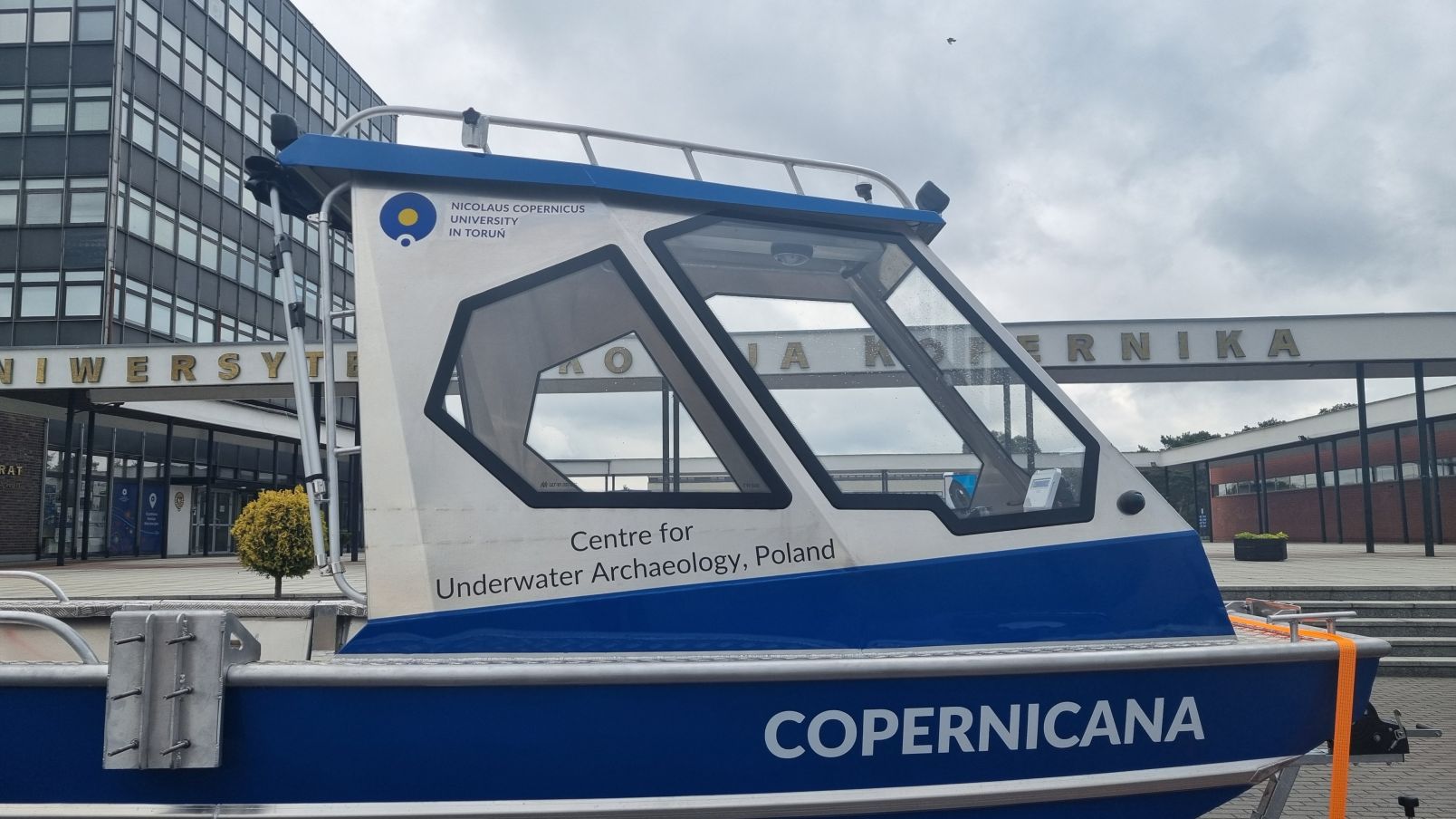
photo: Andrzej Pydyn
The boat was adapted to support diving teams. It is particularly essential in underwater archaeology where hydroacoustic prospecting often constitutes the first stage of research. The object localized with the use of a probe can be precisely verified by divers.
Development in the area of archaeological hydrography and the implementation of acoustic methods are our strategic goals, says Dr Mateusz Popek from the Center for Underwater Archaeology, NCU. – For years, in order to conduct hydroacoustic examinations, we had to use the services provided by external companies. Now, we have our own equipment, and so, the range of our research capabilities is impressive.
The new boat will be an important didactic tool. From undergraduate to postgraduate, students will be able to get acquainted with the whole research process from mission planning and equipment preparation, through performing measurements and data quality control, to their analysis and verification of the results by divers.
The possibilities offered by Copernicana are not limited exclusively to archaeology. The Center is planning to cooperate with the other Faculties at the NCU, different universities, museums, public institutions as well as commercial partners, providing access to not only specialized equipment but also the experience of the team.

photo: Mateusz Popek
– International research currently ongoing in the UNESCO Center for Underwater Archaeology in Zadar, Croatia as well as the Practical Mariner project implemented in Corsica with the Oxford University confirm the validity of this unit disposal, says Prof. Pydyn. – It is already a tool used for cooperation in international projects.
Source: Nicolaus Copernicus University News Portal