
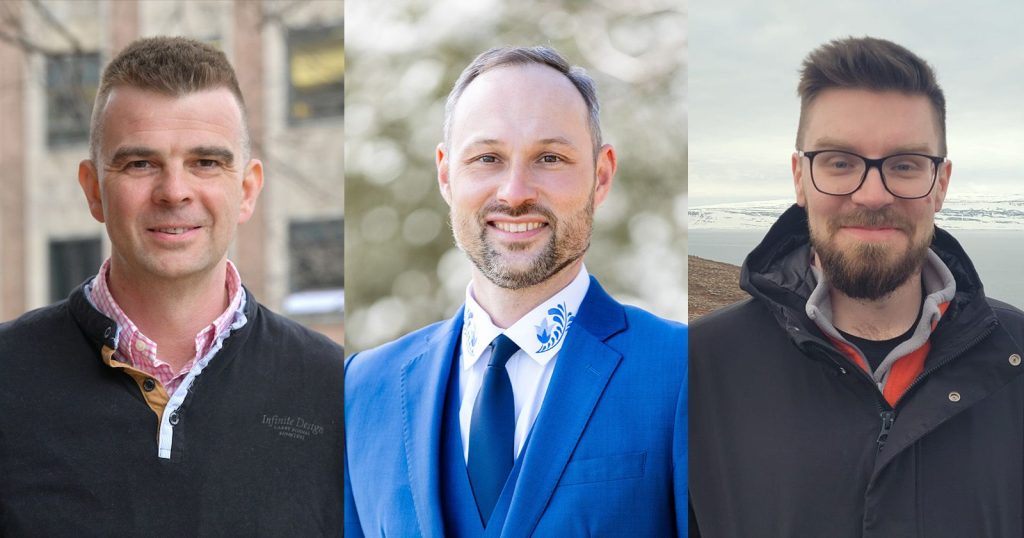
Three researchers from Nicolaus Copernicus University in Toruń have been awarded scholarships in this year’s edition of the Mieczysław Bekker Programme. The competition is organised by the National Agency for Academic Exchange.
The Bekker Scholarship Programme enables doctoral students and research and teaching staff from Polish research institutions to travel to academic centres around the world for a period of 3 to 24 months. The competition is open to people representing all fields of science. The stay abroad allows scholarship holders to establish long-term cooperation, carry out projects in international teams, and opens up the possibility for younger scientists to undertake postdoctoral internships or complete part of their education at doctoral schools.
Among the researchers who received the Bekker scholarship were three scientists from the Nicolaus Copernicus University in Toruń. As part of the grant, Dominik Antonowicz, professor at the Faculty of Philosophy and Social Sciences, will undertake a research trip to Tampere University (Faculty of Management and Business) in Finland. Together with the Finnish Higher Education Group (HEG), he will develop research on the relations between higher education institutions and their social and economic environment in the context of non-metropolitan areas.
Krzysztof Celuch, professor at the Faculty of Economics and Management at Nicolaus Copernicus University, will conduct six months of research at San Diego State University School of Hospitality and Tourism Management. In collaboration with researchers from the United States, he will develop the project ‘Event Experience and Design: Transformative Approaches’.
Dr Hubert Jóźwiak from the Faculty of Physics, Astronomy and Applied Computer Science also received a scholarship for the trip and will carry out the project in Dr Tijs Karman’s group at Radboud University Nijmegen in the Netherlands. The aim of the research is to solve a fundamental problem in the physics of systems cooled to temperatures close to absolute zero: unexplained particle losses in optical traps, which prevent the formation of stable quantum gases. By combining rigorous quantum calculations with statistical models that take spin interactions into account, scientists will learn about the mechanisms governing the formation of long-lived complexes during so-called ‘sticky collisions’. Understanding and controlling these processes will pave the way for the development of new platforms for quantum engineering and simulation. The project will last 24 months.
Source: NCU Information Portal