
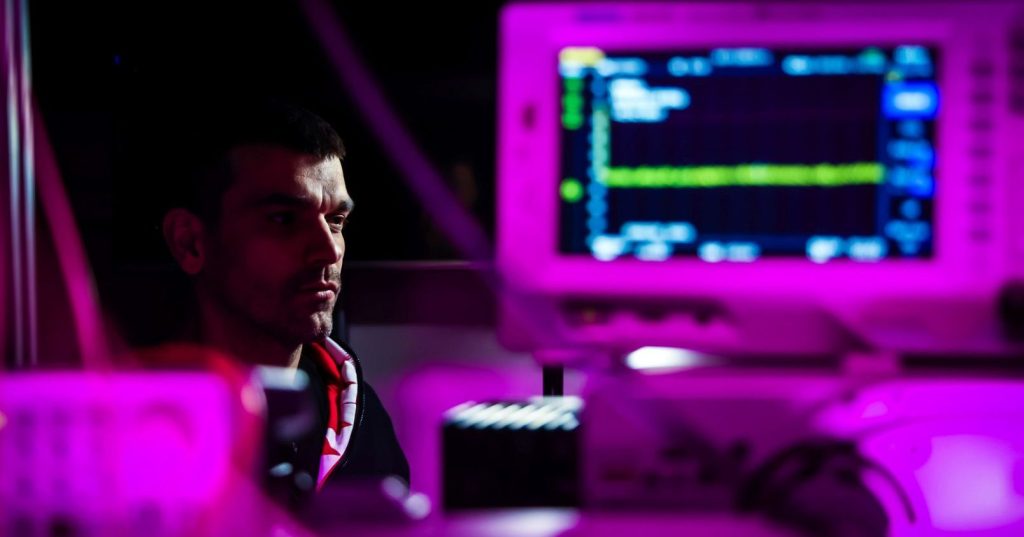
Researchers at Nicolaus Copernicus University (NCU) have developed instrumentation unique on a global scale. The latest issue of Nature Physics reports on studies conducted using this apparatus. – In Toruń, we are developing some of the most advanced quantum technologies – not only for practical applications. Our goal is to push the boundaries of knowledge – says Prof. Piotr Wcisło of the Institute of Physics at NCU.
The article Cavity-enhanced spectroscopy in the deep cryogenic regime for quantum sensing and metrology has just been published in one of the world’s most prestigious scientific journals, Nature Physics.
A group of scientists from the Institute of Physics at NCU describes a system unique on an international scale, which they constructed themselves within the National Laboratory FAMO (KL FAMO). The system makes it possible to transfer leading laser spectroscopy technologies to the regime of cryogenic temperatures and to conduct studies of quantum theory for molecules with an unprecedented level of precision.
The team of authors comprises: MSc Kamil Stankiewicz, MSc Eng. Marcin Makowski, PhD Eng. Michał Słowiński, MSc Eng. Kamil Leon Sołtys, MSc Bogdan Bednarski, PhD Hubert Jóźwiak, PhD Nikodem Stolarczyk, PhD Eng. Mateusz Narożnik, Dariusz Kierski, PhD Szymon Wójtewicz, DSc Agata Cygan, NCU Professor, PhD Eng. Grzegorz Kowzan, DSc Piotr Masłowski, NCU Professor, DSc Mariusz Piwiński, NCU Professor, Professor Daniel Lisak DSc, and Professor Piotr Wcisło DSc.
We have succeeded in creating something truly exceptional: we brought together a large group of extraordinarily talented young researchers around our scientific ideas and secured substantial funding from both Poland and abroad – says Prof. Piotr Wcisło of the Chair of Atomic, Molecular and Optical Physics at the Faculty of Physics, Astronomy and Informatics, Nicolaus Copernicus University. – Thanks to this intellectual potential, the resources we obtained, and nearly a decade of systematic work guided by clearly defined goals, we have built scientific instrumentation unavailable anywhere else in the world. It allows us to view physics and quantum mechanics from a perspective that has never before been accessible.
Laboratory cold
The physicists constructed an exceptionally sensitive spectrometer based on an optical cavity – a well-known device whose operation the NCU team has extended into the so-called deep cryogenic regime. The instrument operates at temperatures down to 4 kelvin (approximately −269 °C), close to absolute zero.
Such extremely low temperatures are crucial: molecules move much more slowly, their spectral signatures cease to be blurred (the Doppler effect is significantly reduced), absorption features become sharper, and the number of accessible motional states decreases, simplifying the spectrum. In addition, gaseous impurities “freeze out” and no longer interfere with the measurement, while the complex spectra of larger molecules become easier to interpret.
What does the device housed in the laboratory on Grudziądzka Street look like? Its design is based on an optical cavity – a system of two mirrors with an exceptionally high reflectivity and extremely low energy loss. The cavity traps light for extended periods: the beam reflects back and forth between the mirrors, effectively increasing the optical path length to several, and even more than ten, kilometres.
The cavity is enclosed in a specially designed 79-cm-long copper vacuum chamber. The inner chamber is suspended on thin titanium supports to minimize heat inflow and suppress vibrations – a critical requirement, as even minute mechanical disturbances could compromise such high-precision measurements. The researchers also installed a dedicated laser – an optical parametric oscillator – generating light at the required wavelength.
– The light is tuned to the cavity with extraordinary precision so that it is perfectly matched to it. This is achieved using frequency stabilization techniques – explains Prof. Wcisło. – The frequency of this light is then compared to that of an optical frequency comb – a laser-based system capable of measuring optical frequencies with extremely high precision. The comb is in turn referenced to a hydrogen maser, a highly accurate atomic clock synchronized with official UTC time. In practice, this means that the frequency of the measured light is referenced to one of the most precise time standards in the world.
As a result, the entire system enables measurements of molecular properties with extreme precision, under full control of temperature, mechanical stability and frequency stability.
Prof. Wcisło emphasizes that the greatest challenge was not merely cooling the gas itself, but cooling the entire measurement system – including the mirrors and the mechanism controlling the cavity length.
– The key is to ensure that all components share the same temperature and remain in thermodynamic equilibrium. It was also necessary to isolate the instrument effectively from vibrations and external disturbances, especially those generated by the cryogenic cooling system. The result is a spectrometer capable of stable, ultra-precise operation under extreme cold conditions – he says.
Hydrogen in extreme cold
For their experiments at cryogenic temperatures, the researchers selected molecular hydrogen. This simplest of molecules is of fundamental importance: its structure can be calculated from first principles, making it an ideal system for testing the principles of molecular quantum mechanics and quantum electrodynamics.
– From a physical standpoint, a hydrogen molecule is a four-body system – two massive protons bound together by a ‘cloud’ of two electrons, which can be set into oscillatory motion and rotation. However, it is essential to remember that this is a microscopic object governed by quantum rather than classical mechanics. Instead of classical rotations and vibrations, we therefore speak of quantum rovibrational states – explains Prof. Wcisło. – The fundamental difference between classical and quantum descriptions is that bound quantum states can assume only strictly defined, discrete energy values. The most common method for studying such states is molecular spectroscopy, which involves placing molecules in an electromagnetic field and observing which frequencies are absorbed.
The tip of the iceberg
Prof. Piotr Wcisło acknowledges that the very first measurement campaign has already yielded a result of considerable physical significance.
We have tested quantum theory for a four-body system at the highest level of precision. Until now, no one has performed cavity-enhanced spectroscopy with such high resolution at such low temperatures, under full thermal equilibrium – he says. – And it is worth emphasizing that this was accomplished here in Toruń. This is entirely Polish technology – from the original concept, through design and construction, to the most precise measurements. That is important. Our country is beginning to participate seriously in the development of contemporary science – not only in theoretical physics, but also in advanced technologies and state-of-the-art experimental systems. We are now demonstrating that it can be done. Our ambition is for Toruń, Nicolaus Copernicus University and our Institute of Physics to become permanent members of the global forefront of modern quantum physics.
The physicist notes that his team’s latest publication in Nature Physics represents only the tip of the iceberg. The quantum technologies they have developed open the way to a series of entirely new research programmes unavailable to any other group worldwide.
Researchers at NCU are already developing ultra-precise tests of quantum chemistry, including quantum-mechanical calculations for far more complex systems, such as intermolecular interactions. They seek to understand how atoms and molecules interact and how they behave during collisions. At very low temperatures, subtle quantum effects emerge; in many cases, experimental results do not fully agree with theory, and the reasons remain unclear.
– Collisions at the microscopic scale are not classical collisions. They should be viewed more like light scattering from glass or water. Colliding molecules, in essence, constitute the scattering of matter waves in the quantum-mechanical sense – Prof. Wcisło explains.
Another major project based on these quantum technologies involves providing astronomers and astrophysicists with molecular data essential for studying the atmospheres of planets, planetary moons and exoplanets.
This is one of the hottest topics in contemporary science. What does chemistry look like beyond our Solar System? Does biology exist there? Does life exist? To answer such questions, astronomers require robust molecular data generated in laboratories such as ours – he says.
A further area in which the Toruń technology may have significant impact is the development of standards for the International System of Units (SI). As Prof. Wcisło explains, a major shift occurred in 2019, when most SI units were redefined. They are no longer based on physical artefacts – such as the metal cylinder stored near Paris, the International Prototype of the Kilogram – but instead on the laws of physics and fundamental constants of nature. The kilogram, for example, is now defined by a fixed numerical value of the Planck constant.
A technological race is under way worldwide to determine which group will establish the most accurate quantum standards for these SI units. The technologies we have developed place us in a privileged position on several fronts of this race – Prof. Wcisło adds. – However, the practical applications of our technologies are merely a “side effect”. Our true objective is to push the boundaries of knowledge – to achieve the deepest possible understanding of the structure of reality.
Source: NCU Information Portal